Checking the public record
Parkrose School Board
October general-fund forecast review
What explanation did staff provide for the opening-balance revision, payroll mix and remaining cushion, and what follow-up did the board request?
The district’s latest general-fund forecast leaves less than one cent of projected cushion for every dollar of spending. Three monthly reports show a sharp opening-balance revision, a partial October recovery and the questions the board can press Monday.
1 min 11 sec · Hosted by Kit Serrano, a fictional Portland, In View journalist. Narrated with Ryan, a synthetic voice.
Download audio (M4A)If you have a student in Parkrose, what does a smaller budget cushion mean for their school? To answer that, start with the bottom line on the district’s monthly worksheet. It estimates how much money will be left when the school year’s bills are paid.
In August, Parkrose put that figure at about nine hundred sixty-two thousand dollars. By October, it was down to about three hundred eighty-nine thousand. Against nearly forty-one million dollars in expected spending, that leaves less than a penny for each dollar the district expects to spend.
Here’s the line underneath that change. The district revised how much money it expected to carry over from the previous year. So if you’re looking for a list of classroom cuts that adds up to the difference, the worksheet can’t give you one.
The school board’s November twenty-third agenda puts the forecast under department reports. One question for families to follow in the meeting record is what changed when the district closed the previous year’s books. Another is whether that smaller margin calls for any changes during this school year.
I’m Kit Serrano, a fictional journalist for Portland, In View. This episode uses an AI-generated voice. The district’s worksheets and meeting agenda are linked in the story.
Parkrose School Board
What explanation did staff provide for the opening-balance revision, payroll mix and remaining cushion, and what follow-up did the board request?
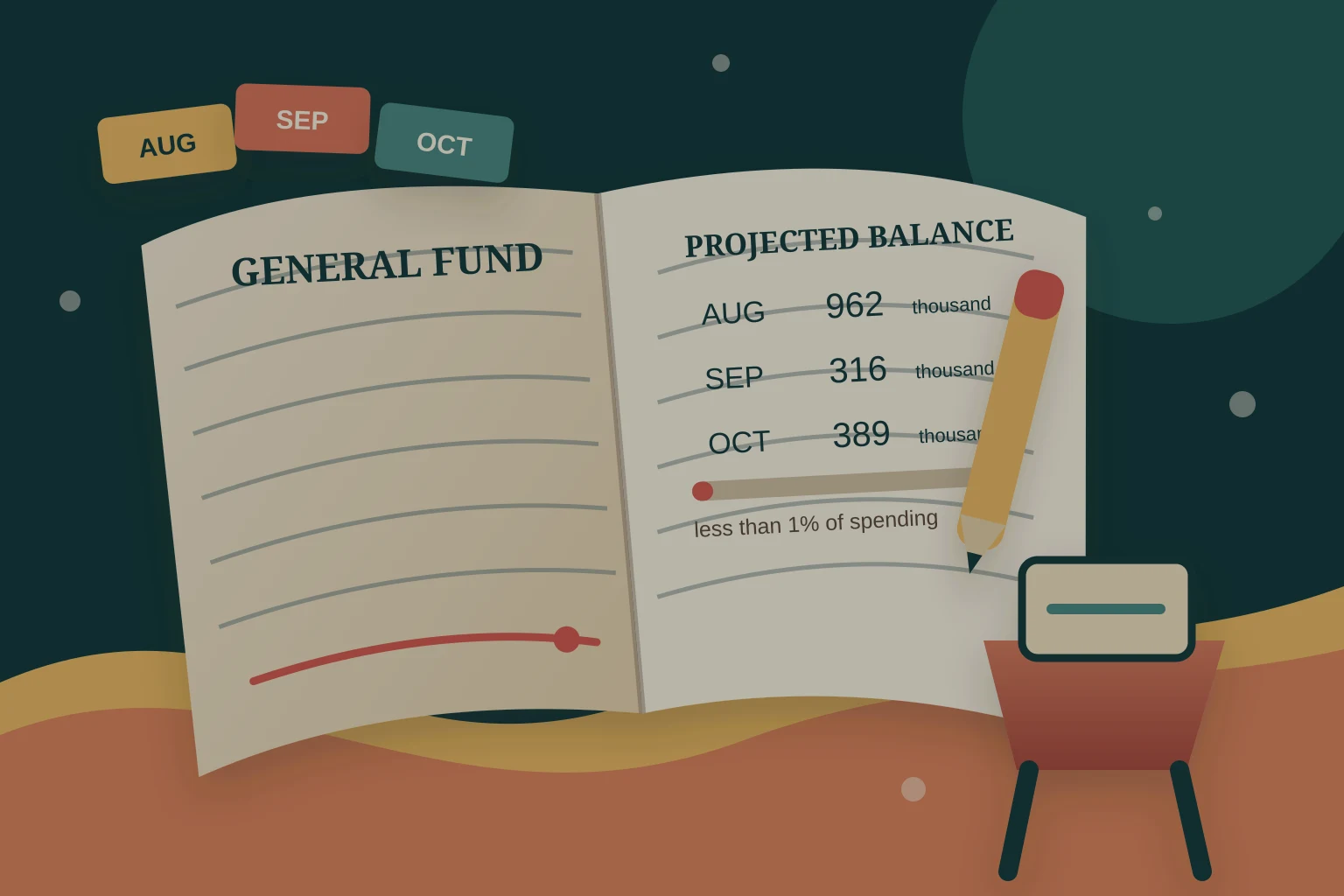
Parkrose School District’s October general-fund forecast projects $41,184,436 in resources and $40,795,258 in expenditures for the 2026–27 school year. The difference is $389,178. That arithmetic works: $41,184,436 minus $40,795,258 equals $389,178.
The number is more useful in context. The district’s August report projected a $962,235 year-end balance. September cut the forecast to $316,379. October raised it to $389,178. The current projection is therefore $72,799 better than September but $573,057 below August—a 59.6% reduction across the three reports.
Each worksheet is a forecast assembled from activity recorded so far and assumptions for the remaining months. The district prints the same warning in capital letters: the estimates are subject to change and will not be the final year-end fund balance. The chart shows the reported projections, not cash available today and not audited results.
The August report carried the adopted beginning balance of $1,218,045 into its full-year projection. The September report kept that adopted figure in one column but applied a negative $986,999 adjustment, leaving a revised beginning balance of $231,045. October carried the same $231,045 forward.
That single revision is larger than the current projected cushion. It does not mean Parkrose spent $987,000 during September. A beginning balance belongs to the prior fiscal year’s closing position; it can change as the district closes its books and replaces a budget assumption with a more current estimate. The worksheets do not explain the program-level causes of the adjustment.
Citizen Portal reported on October 30 that the district’s chief financial officer told the board the lower beginning balance followed special-education costs more than $3 million above budget. The official October 26 meeting video is the underlying public record, and the district’s own agenda identifies the September financial report. We credit that prior report for surfacing the explanation. We have not treated the $3 million as a line in the current-year worksheets: the October forecast does not break the $986,999 revision down by program, and a prior-year cost overrun is different from the current-year ending-balance projection.
The sequence also shows why the opening-balance change cannot be subtracted mechanically from the August cushion. Between the August and September forecasts, other resource and spending assumptions moved too. The starting balance fell $987,000, but the projected year-end cushion fell $645,856. Changes elsewhere offset about $341,144 of the opening-balance reduction.
| Monthly report | Beginning balance used | Projected year-end balance |
|---|---|---|
| August | $1,218,045 | $962,235 |
| September | $231,045 | $316,379 |
| October | $231,045 | $389,178 |
What prior-year closing entries produced the $231,045 beginning balance, and when will Parkrose publish the final audited reconciliation? The monthly sheets show the adjustment but not its accounting components.
From September to October, projected resources rose by $47,730 and projected expenditures fell by $25,069. Those two changes add to the $72,799 improvement in the projected year-end balance.
The resource change was not a broad surge. Projected local revenue fell $286,457, mostly because the prior-year tax and investment-earning assumptions came down. The forecast added $328,000 in City of Portland Arts Tax revenue that had been shown as zero in the first two reports, and projected state sources rose $6,187. With the beginning balance unchanged, those movements net to $47,730 more resources.
The spending side also contains offsetting movements. Projected salary and benefit costs together fell $275,817 from the September forecast. Projected contracts rose $258,981. Supplies, dues and fees fell by $8,233. The net is $25,069 less projected spending. This is why a single improved bottom-line number should not be mistaken for improvement in every category.
| September to October change | Effect on cushion |
|---|---|
| Projected resources | +$47,730 |
| Projected expenditures | −$25,069 |
| Projected year-end balance | +$72,799 |
The Arts Tax line illustrates a forecast change, not necessarily a new award received in October. It was budgeted at $325,000, shown as zero in the August and September full-year projections, and restored at $328,000 in October. The report does not state why the timing assumption changed.
Parkrose projects regular salaries at $22,446,948, which is $1,347,532 above the adopted salary budget. Extra and substitute salaries add a $13,100 overage. Benefits are projected at $10,227,726, or $2,287,644 below budget. Taken together, salaries, substitute pay and benefits are $927,012 below the adopted total.
That combination can occur when positions, vacancies, benefit selections, rates or payroll coding differ from the assumptions used to build the budget. The worksheet does not identify which explanation applies. A lower benefit projection can offset higher salary spending on paper without making the salary pressure disappear.
The October report projects $33,519,637 for salary and benefits—82.2% of all projected general-fund expenditures. That makes the assumptions especially consequential. A one-percentage-point change in that combined projection would be about $335,000, close to the entire forecast cushion. This is a scale comparison, not a prediction that costs will move by one percent.
| October projection | Adopted budget | Projected total | Variance |
|---|---|---|---|
| Regular salaries | $21,099,416 | $22,446,948 | $1,347,532 over |
| Extra/substitute salaries | $831,864 | $844,964 | $13,100 over |
| Benefits | $12,515,370 | $10,227,726 | $2,287,644 under |
| Combined | $34,446,649 | $33,519,637 | $927,012 under |
How much of the salary overage reflects filled positions, substitute use or reclassification, and how much of the benefit savings is expected to persist through June? The answer matters because the combined payroll forecast is much larger than the remaining cushion.
The projected cushion equals about 0.95% of the $40.8 million spending forecast—less than one cent for every dollar. That ratio is a plain-language way to show sensitivity; it is not a formal reserve-policy test. A district can have restricted money outside the general fund, timing differences in cash receipts and obligations that do not appear in this two-page summary.
The worksheet also leaves the $250,000 contingency and $150,000 transfer lines unspent in its full-year projection. That helps the bottom line, but it does not establish that those amounts will remain untouched. Conversely, the report projects contracts $113,160 below budget and total salary and benefits $927,012 below budget. Those savings are benefits of the current forecast and should not be ignored simply because the ending margin is small.
The strongest interpretation is therefore neither crisis nor comfort. Parkrose currently forecasts finishing the year above zero, after a substantial reduction in the starting balance and with several large assumptions offsetting each other. The board’s job Monday is to understand which assumptions are known, which are still estimates and what would trigger corrective action before June.
A forecast can be useful without being final. It lets the board ask early questions and lets the public compare each revision. It cannot substitute for audited year-end statements, cash-flow detail or program-level spending records.
The elected Parkrose School Board meets Monday, November 23, at 6:30 p.m. in the district office boardroom and online. Chief Financial Officer Sharie Lewis is listed as presenter for Business Services and Operations. Item 10.A.1 is the monthly general-fund report, followed by a separate board-budget update.
The agenda places both under department reports, not action items. That means Monday’s listed step is review and questioning, not adoption of a revised budget. The board can still direct follow-up, request clearer reporting and later consider formal transfers or amendments when those actions are properly posted.
Residents may use the online public-comment form before or during the meeting, before the public-comment item arrives on the agenda. In-person speakers fill out an Intent-to-Speak card and give it to the board administrative assistant before the in-person comment item. The district allows three minutes per in-person speaker. The agenda provides the authoritative access link and meeting order.
The two-page report supplies current and projected resources, expenditures and the district’s warning that the estimates will change.
Status: Forecast available; no final result
The agenda lists the general-fund forecast as a department report. Public comment comes before the department reports.
Status: Review scheduled; no budget vote listed
The public record can then show what explanation staff gave, what directors asked and whether the board requested follow-up.
Status: Outcome not yet available
Year-end statements and the later audit can show the actual closing balance and explain the remaining differences.
Status: Future accountability check
First: what entries reduced the beginning balance from $1,218,045 to $231,045, and when will the district publish the final prior-year reconciliation? Second: what changed between September and October to restore the $328,000 Arts Tax projection? Third: which staffing or rate assumptions produce the $1.36 million combined salary overage and $2.29 million benefit savings?
Fourth: how much of the $389,178 cushion is available for an unexpected current-year cost, after commitments not shown in the two-page forecast? Fifth: what threshold would cause staff to recommend a spending freeze, transfer, appropriation change or other board action?
These questions do not assume the forecast is wrong or that the district acted improperly. They test whether a reader can reproduce the number, understand why it moved and know what happens if the assumptions change. That is the difference between treating a budget as a static document and using it as a public management tool.
Can the next monthly report add a short bridge from the prior forecast to the current one? A table showing each material change in beginning balance, revenue and spending would let directors and residents see what moved without reconstructing three PDFs.
We compared three successive Parkrose general-fund forecasts line by line, reproduced the arithmetic and kept adopted budget, revised estimate, cash timing and final results distinct. We checked the November 23 agenda and the district’s official October 26 recording, then searched for earlier outside coverage. No district employee or board member was contacted. This is not an audit, and the current projection can change.